
Brand differentiation: how it can make or break a business
What do Jet Skis, Hoovers and Velcro have in common?
They’re all brand names that have become shorthand for their respective categories. No-one asks for a personal watercraft or a hook and loop fastener. We all fall back to the brand name, and everyone understands.
Owning a category as these brands do is extremely tough to achieve – but differentiation shouldn’t be ignored.
Get it right, and it can make your business. Getting it wrong however can gradually eat away at your bottom line to the point that you’re only competing one way: price.
Kantar research has found that the brands that win are meaningfully different at every touchpoint. And that’s not just B2C mega brands. That’s true for B2B SMEs as well.
What is brand differentiation and why does it matter?
The author Rory Sutherland (TED speaker and Vice Chair of Ogilvy & Mather Group) has a quote:
“Having a great brand means you get to play the game of capitalism on easy mode. Because people are drawn to you and more likely to trust you.”
But what do we mean by a ‘great brand’? Ask 20 marketers that question and you’ll likely get 20 different answers, but in general, great brands tend to:
- Have unique or distinctive ‘brand assets’ that make them easy to remember
- Be rooted in fundamental truths about the product and the customer
- Clearly communicate their value proposition to the customer in a way that resonates with them
Your brand is a driver of choice. You build a brand so people choose you over others. Or at the very least include you in their consideration set.
The goal of brand differentiation is to make your brand distinctive, memorable and as relevant to the customer as possible. This will help your message land – and help customers remember you when they enter some kind of buying cycle.
So what is product differentiation?
Product differentiation is a marketing strategy for distinguishing your product or service from your competitors. It’s what makes your brand stand out and what makes it special. When it comes to communicating your product differentiation, the approach should be two-fold. Product differentiation forms part of, but isn’t quite the same as, brand differentiation.
How to differentiate your product
To differentiate your product you need to be able to:
- Identify and express your product’s unique qualities.
- Demonstrate to your audience the distinct differences between your product and your competitors’.
- Demonstrate the benefits of choosing your product over a competitor’s.
Product differentiation can be communicated through the product’s name or slogan, advertising and marketing campaigns, packaging and presentation, price point and customer experience: any aspect of the product that has a potential impact on the customer.
When done well, product differentiation helps build brand awareness and creates a competitive advantage. When done poorly, your brand will fade into the shadow of your competitors.
Types of product differentiation
There are three main types of product differentiation: vertical differentiation, horizontal differentiation and mixed differentiation.
Vertical product differentiation. This type of product differentiation focuses on price over quality. Think of supermarket value ranges and you’re on the right lines.
Horizontal product differentiation. This refers to product differentiation that is not related to price or quality and is mainly focused on consumer preference; choosing the accountancy platform Xero over a competitor like Sage, for example.
Mixed product differentiation. Mixed differentiation generally occurs with more complex buying decisions where a number of different factors are involved. So, when choosing a new bike, for example, you will want to be sure that it has the right spec to meet all your commuting and recreational needs, but you’ll also want it to look great, too.
What are the signs of a brand differentiation problem?
An undifferentiated brand will see signs:
- Decreasing returns on sales and marketing activity.
- Having to work harder to generate the right attention, opportunities and leads.
- With a dwindling pipeline, it’ll start to see a gradual decline in profits, too.
Many businesses combat this by discounting more and fighting a battle on price point alone: red flags all round.
So how do you know if brand differentiation is a problem for you?
The best way to diagnose a brand problem is to look at your sales. Not hitting targets? How often does the phone ring? How much margin are you making? Are you under price pressure? How loyal are your customers?
These issues come about because people see you as interchangeable with others. Look at supermarkets’ own-brand products. They don’t market themselves, there is no branding, they don’t offer anything different to the rest of the shelf – on purpose. They are specifically designed to compete with the likes of Heinz or Kellogg’s on cost alone.
If you struggle to explain what your business does differently, or if your marketing materials are clichéd and lack depth, lack of brand or product differentiation is likely the cause.
Aside from the impact on marketing ROI and the bottom line, don’t ignore your gut instinct. Many business owners know in their heart of hearts that they’re not saying anything different to any of their competitors. This can have a dramatic impact on motivation and drive: and if the owner’s feeling it, the business will feel it too.
How can you build a meaningfully differentiated brand?
When people talk about “brand” they often think about visual elements like logos or colour schemes. But these things are actually expressions of a deeper underlying narrative.
To build a meaningfully differentiated brand start with concrete things like unique product features and attributes, then use them to define more abstract things like brand personality, tone of voice and customer-facing strapline. This helps keep things grounded in the reality of the product.
As an example, all cars have wheels and engines. You can’t differentiate much there. But maybe you’ve built a car that is great off-road. What does that mean? Well, it means freedom. Perhaps it means the spirit of adventure.
That’s what can differentiate a brand like Land Rover from BMW or Mercedes. The key thing is that it starts with the product.
Separate the givens from the differentiators
In marketing, there are givens, and there are differentiators. Givens are vital: without them, customers won’t do business with you. A quality product; knowledgeable people; excellent customer service – you need these just to be in the game. They’re the same things that your competitors boast of, too.
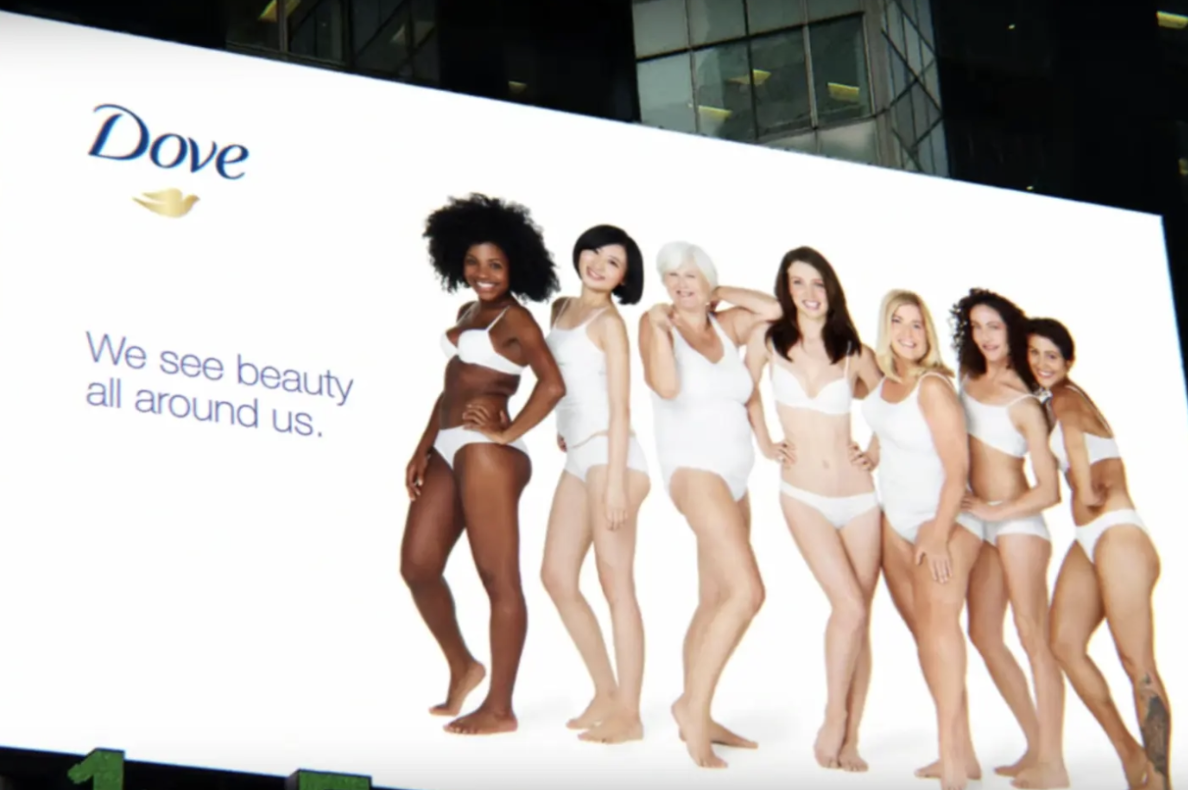
Dove, for instance, was a quality if serviceable personal care brand. In 2004, it launched the Campaign for Real Beauty, a campaign that redefined the accepted norms of what beauty was and was a hit on social media. Instead of the usual size zero models, Dove put normal women front and centre.
Dove set out a mission – a brand value that persists to this day. Crucially, it had a huge impact on the bottom line, too: Real Beauty led to a 700% rise in sales of Dove in the first half of 2005.
Closer to home, financial advisory firm Menzies was known as a high-quality effective business, but a slew of low-cost online accountancy solutions had begun slowly eating into their profits.
The goal was to find the position that would best serve their purposes, that would enhance the existing Menzies culture. The outcome of this was ‘Brighter Thinking’: a concept which conveyed how Menzies wanted to portray themselves, but also encapsulated what their target market was looking for in a long-term relationship with an accountancy firm. Customers needed to hear “we know you can’t play quick and fast with a customer’s finances. You need smart people making smart decisions.”
For Dove, they differentiated by talking outside the product itself, aligning it with a movement – a campaign.
For Menzies, it was about highlighting their finance and accounting expertise, combined with strategic commercial thinking. Neither, you’ll notice, mentioned price at any point.
The brand differentiation trick: keep it clear
While there is creativity at play here it’s also important to keep things clear and easy to understand. Especially in B2B markets where marketing can become laden with technical jargon.
Whatever your message is, it needs to be understood by people on the outside of your business.
That is the real creative challenge. Encapsulating your unique differentiators in a way that’s compelling and interesting but also crystal clear.
Business owners can struggle to recognise their differentiators because they’re so close to them. This is why they often need experienced specialists who aren’t as close to the day-to-day to look at things from a fresh perspective.
Here’s an example.
A few years ago The Marketing Centre worked with a wonderful company that made clinical wipes. At that time they were number two in the UK, but the reality was that their product was superior to the market leader.
Without going into detail, a quirk of their manufacturing process meant that the last wipe would be just as effective as the first, while the market leaders’ were less effective near the bottom of the pack. A chap on the factory floor showed me this on a factory tour. Nobody thought to tell that story before because they’re chemists, not marketers.
Where do you start?
Imagine that you’re sitting at a table. On the one side is your business and all your competitors, and on the other side are your customers. Each has one sentence to convince the customer to use them instead of the competitors. What would you say?
It’s important to realise that this meeting takes place every time a customer decides on a specific brand, service or product to buy. The only difference is, it happens in their minds.
Here are a few questions to help you understand what your one sentence would be:
- What is the problem your customer is trying to solve?
- How would you solve that problem?
- Why should they choose your product or service over your competitors’?
For instance, our answer could be:
We help business owners to improve their marketing by giving them access to experienced part-time Marketing Directors with a proven track record of growth.
Take it back to your customers
Finding unique product angles is a good start, but you also need to sense-check them. Just because something sounds great to you, doesn’t mean your customers will agree.
All of the work you’re doing here needs verification. It’s all very well doing this work in your own head or on a piece of paper, but you need to take it back to the customer and see what they think. If it doesn’t resonate with them, it’s not right.
Speaking to customers can also help you uncover those unique truths about your own business that you weren’t aware of.
Business owners often have a very clear view on their market, but their customers won’t necessarily share that view – and it’s a huge mistake to assume they will. Your value proposition is really about them. So much of brand building is about seeing things from the customer’s perspective.
Seize the advantage your competitors are missing
The benefits of a truly differentiated business manifest in a few different ways. First, are all the benefits that come with having a strong, unique brand:
- More profit
- Lower cost per acquisition (CPA)
- A more valuable business
- Faster, more sustainable growth
A great brand makes it cheaper, quicker and easier to generate leads and close them. It also makes existing customers less likely to churn.
If you’ve nailed differentiation you will be able to say with confidence who you are, what you do and why you do it. You’ll be able to say the business helps [X] to do [Y] by doing [Z]. You’ll have carved out your niche within the market, and be able to explain exactly what it is you do that your competitors don’t. On the marketing front, you’ll be able to explain what you do to people easily, without falling back on tired clichés or ‘givens’ to explain your positioning.
Lastly, your business mindset as a whole will improve once your vision is clearer. Differentiation carves a niche in the market, inspires everyone within the business, focuses the company mission and revitalises the brand’s momentum and growth.
And yet, most B2B SMEs deprioritise brand in favour of lead generation because the latter is easier to measure and, in theory, promises a more reliable short-term return on investment – but we’ve seen it time and time again in businesses both big and small. Great brands build great businesses.
If you find yourself always competing on price, if your cost per acquisition is increasing, or if you simply know that your business is saying nothing new, differentiation – or lack of – is often the root of the problem. Pull the business apart and work out what it is you do, where you sit in the market and how you differ from the competition, and you’ve created a platform to break through the growth barrier.
Get it right, and you’ll notice the difference to your bottom line.
What’s your Marketing Maturity Score?
Take 10 minutes to understand your marketing performance and identify areas to prioritise with our Marketing 360 Assessment.
You’ll get a detailed report breaking down your performance, full of personalised advice to help you improve any areas where you’re struggling. We also offer a free consultation to help you interpret your results and turn them into an action plan.
Click here to get your Marketing Maturity Score.