Most business owners reach a point where growth becomes harder work, even though marketing activities continue.
Sales take longer to close. Marketing activity feels busy but less effective. The team is working harder, yet results are flatter than they used to be. It is easy to assume this is an internal issue that needs fixing or pushing through.
In reality, this is often the moment when the market has changed. Customers buy differently. Competitors reposition. Costs rise. Demand softens. What worked a few years ago no longer delivers the same results. When this happens, growth slows not because the business is failing, but because the environment around it has shifted.
When markets mature or competition increases, traditional marketing approaches deliver diminishing returns. Growth often slows not because businesses are doing less, but because customer behaviour, competition, and expectations have changed.
Recognising that difference is critical for making the right decisions.
When the market, not the business, is the problem behind slowed growth
Markets rarely change overnight. Shifts tend to be gradual, which is why they are often missed while the focus is on day-to-day delivery.
Common market changes that affect business growth include:
- customers becoming more cautious or price sensitive
- increased competition targeting the same audience
- longer decision-making cycles
- greater pressure on margins
- higher expectations around service, experience and communication
Individually, none of these feel dramatic. Together, they quietly make growth harder. We find that one of the most common causes of slowed business growth is market change, not internal failure.
Why pushing marketing harder often makes things worse
When business growth slows, the natural reaction is to increase marketing activity. More sales calls. More campaigns. More pressure on the team.
If the market has changed, activity without direction usually leads to fatigue, not progress.
This is where many businesses get stuck. They are well run, capable and ambitious, but lack clarity on how to respond to a changing market. What is needed is not more effort, but better focus and decision-making.
This is the point where marketing leadership becomes critical.
What marketing really does in tough markets
Marketing is often misunderstood as promotion. Its most valuable role is helping business owners make better strategic choices.
Effective marketing leadership helps to:
- understand how customer needs and buying behaviour have shifted
- clarify which customers remain attractive and which no longer are
- define what the business should be known for now, not in the past
- sharpen positioning to reduce price pressure and improve conversion
- focus time and investment on the opportunities that matter most
In changing markets the primary role of marketing is not promotion, but strategic decision making. This is rarely about radical reinvention. More often, it is about making the right adjustments at the right time.
The role of insight and positioning
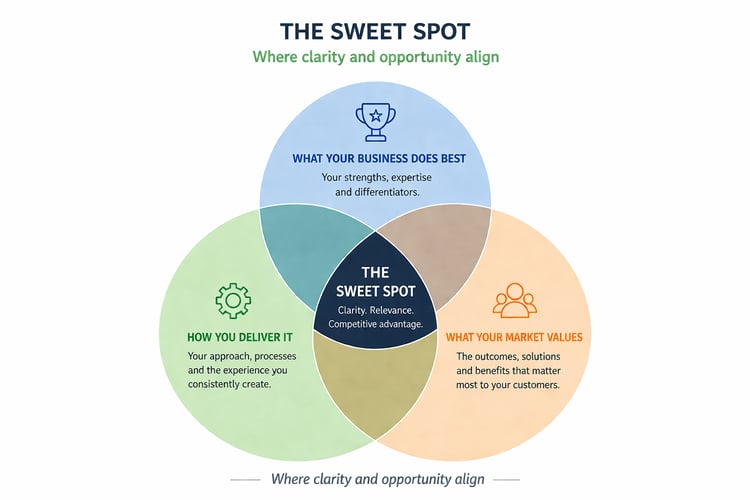
As markets mature or become more competitive, trying to appeal to everyone becomes a weakness.
Businesses that continue to grow tend to make clearer choices. They know who they are for, what problems they solve best, and why customers should choose them.
Marketing insight brings structure to decisions that are often debated informally. It replaces assumptions with evidence and turns opinion into direction.
That clarity supports sales teams, improves marketing effectiveness and helps businesses compete on value rather than price.
Where digital marketing and AI fit in
Digital marketing and AI now play an important role, but they are tools, not strategies.
Used well, they help businesses:
- identify patterns in customer and market data
- improve targeting and relevance
- personalise communication at scale
- make better decisions, faster
Used without leadership, they add complexity and distraction.
The role of senior marketing leadership is to decide where digital and AI genuinely support growth and where they do not.
Why fractional CMOs are part of the solution
Many business owners recognise the need for senior marketing input but do not need or want a full-time CMO.
When business growth slows, a fractional CMO brings experience, perspective and focus at the point it is needed most. They help business owners step back, understand what the market is really doing, and make confident decisions about how to respond.
Because they work across multiple businesses and markets, fractional CMOs bring pattern recognition as well as practical judgement. They know what tends to work, what rarely does, and how to avoid costly mistakes.
Most importantly, they help turn insight into action and accelerate your business growth.
What changes when marketing leadership is in place
When the right marketing leadership is added, businesses typically see:
- clearer strategic priorities
- stronger alignment between marketing and sales
- more effective use of budget and resource
- improved positioning and messaging
- renewed confidence in growth decisions
This is often the difference between feeling stuck and moving forward with purpose.
Responding early makes all the difference
Markets will continue to change. That is inevitable.
The businesses that perform best are not those that avoid change, but those that respond early, with clarity and confidence. They accept that yesterday’s answers are not always right for today’s conditions.
Marketing leadership helps business owners navigate change without overreacting or standing still.
How The Marketing Centre supports business owners
The Marketing Centre provides experienced, part-time Marketing Directors who work alongside business owners to help them respond to changing markets.
Our fractional CMOs bring senior-level thinking, practical insight and hands-on support. They help businesses understand their market, sharpen their positioning and build realistic growth plans that deliver commercial results.